open life blog

Percona.tv: State of the MySQL Ecosystem

In December I covered the topic The state of MySQL forks: co-operating without co-operating (which was also a response to Giuseppe Maxia's take on the same topic). Since half a year has now passed, I was wondering if I should follow up with an update. (Drizzle having a GA release would be the major news in such an update.)

But I see that Peter Zaitsev covered this topic in the opening keynote of their Percona Live conference. Since I agree with Peter's view on this topic, I just recommend you watch the talk on Percona.TV. He also uses the same categorizations of the forks, and includes "community patches" as its separate slide.

Mythbusters: How to configure InnoDB buffer pool on large MySQL servers

Mythbusters: How to configure InnoDB buffer poll on large MySQL servers

Yesterday I wrote about the dangers in using top on systems with 100+ GB of RAM, not to mention future systems with 1+ TB. A related topic is, how should I configure MySQL on such a large system?

There is a classic rule of thumb that on a dedicated MySQL server one should allocate 80% of memory to the InnoDB buffer pool. On a 128GB system that is 102.4 GB. This means that I would leave 25.6 GB of RAM "unused". So surely on these large systems, this old piece of advice cannot hold anymore. If the database was previously running on a server that in total had less than that altogether, it seems wrong to leave so much memory just unused. Let's label the old rule of thumb tentatively a "myth" and ask mythbusters to figure out a new MySQL configuration for us...

top -M or when rounding errors get serious

We all know that a megabyte in binary system is not the same as one million bytes (in decimal system). But have you actually cared much about it? I have to admit I haven't. I know there is a small rounding error, but by and large I always treated 2^10 = 1 kB = 1024 bytes and 10^3 = 1 kB = 1000 as the same thing. (Update: Opening sentence was edited to remove units MB and MiB since it seems even I managed to use them backwards! The math in this article is correct. The rest of the article uses MB, GB and TB mostly to refer to binary magnitudes, which is apparently incorrect. See comments for wikipedia links and discussion.)

More importantly, when you move into larger numbers, rounding errors usually become even less important. Unfortunately, in this case they become bigger:

Cutting into open source business models with a sharp knife and a squeeze

There was a guy on TV (and unfortunately I've forgotten his name) who does crisis management and peace negotiations. You know, mediating when two countries or tribes have been at war. At the opening of peace negotiations he would usually tell the following story:

The different ways of doing HA in MySQL

A week ago Baron wrote a blog post which can only be described as the final nail in the coffin for MMM. At MySQL AB we never used or recommended MMM as a High Availability solution. I never really asked about details about that, but surely one reason was that it is based on using the MySQL replication. At MySQL/Sun we recommended against asynchronous replication as a HA solution so that was the end of it as far as MMM was concerned. Instead we recommended DRBD, shared disk or MySQL Cluster based solutions. Of course, to replicate across continents (geographical redundancy) you will mostly just use asynchronous replication, also MySQL Cluster used the standard MySQL replication for that purpose.

The easy way to manage virtual/cloud images: from the outside with userdata and runurl scripts

In March I posted a series of blog posts on my paternity leave MepSQL project, which I called MepSQL. There was still one piece created in the MepSQL buildsystem that I didn't publish or blog about. Since it is generally useful, I wanted to generalize and polish it and publish it separately. I finally had that done last week, when I also found that somebody else, namely alestic.com already published a similar solution 2 years ago. So yesterday I ported my BuildBot setup to use that system instead and am happy to publish it at the Open DB Camp 2011 in Sardinia.

Ok, so let's go back a little... What is the problem we are solving?

Let's refresh our memory with a picture (and you can also go back and read about it):
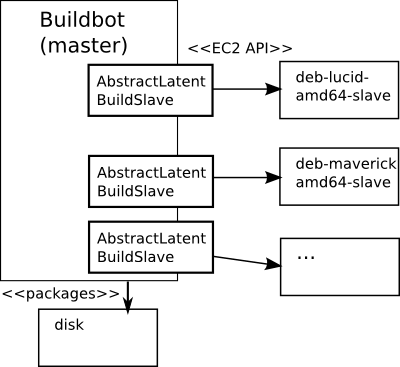
Buildbot and latent buildslaves in EC2 cloud

About the bookAbout this siteAcademicAccordAmazonAppleBeginnersBooksBuildBotBusiness modelsbzrCassandraCloudcloud computingclsCommunitycommunityleadershipsummitConsistencycoodiaryCopyrightCreative CommonscssDatabasesdataminingDatastaxDevOpsDistributed ConsensusDrizzleDrupalEconomyelectronEthicsEurovisionFacebookFrosconFunnyGaleraGISgithubGnomeGovernanceHandlerSocketHard problems in computer scienceHigh AvailabilityimpressionistimpressjsInkscapeInternetJavaScriptjsonKDEKubuntuLicensingLinuxMaidanMaker cultureMariaDBmarkdownMEAN stackMepSQLMicrosoftMobileMongoDBMontyProgramMusicMySQLMySQL ClusterNerdsNodeNoSQLNyrkiöodbaOpen ContentOpen SourceOpenSQLCampOracleOSConPAMPParkinsonPatentsPerconaperformancePersonalPhilosophyPHPPiratesPlanetDrupalPoliticsPostgreSQLPresalespresentationsPress releasesProgrammingRed HatReplicationSeveralninesSillySkySQLSolonStartupsSunSybaseSymbiansysbenchtalksTechnicalTechnologyThe making ofTransactionsTungstenTwitterUbuntuvolcanoWeb2.0WikipediaWork from HomexmlYouTube

Search

Recent blog posts

Recent comments